
2026-10-23 · 9 min read
Crackle Lacquer Factice: Why It Is Hard to Copy | Key-Joint
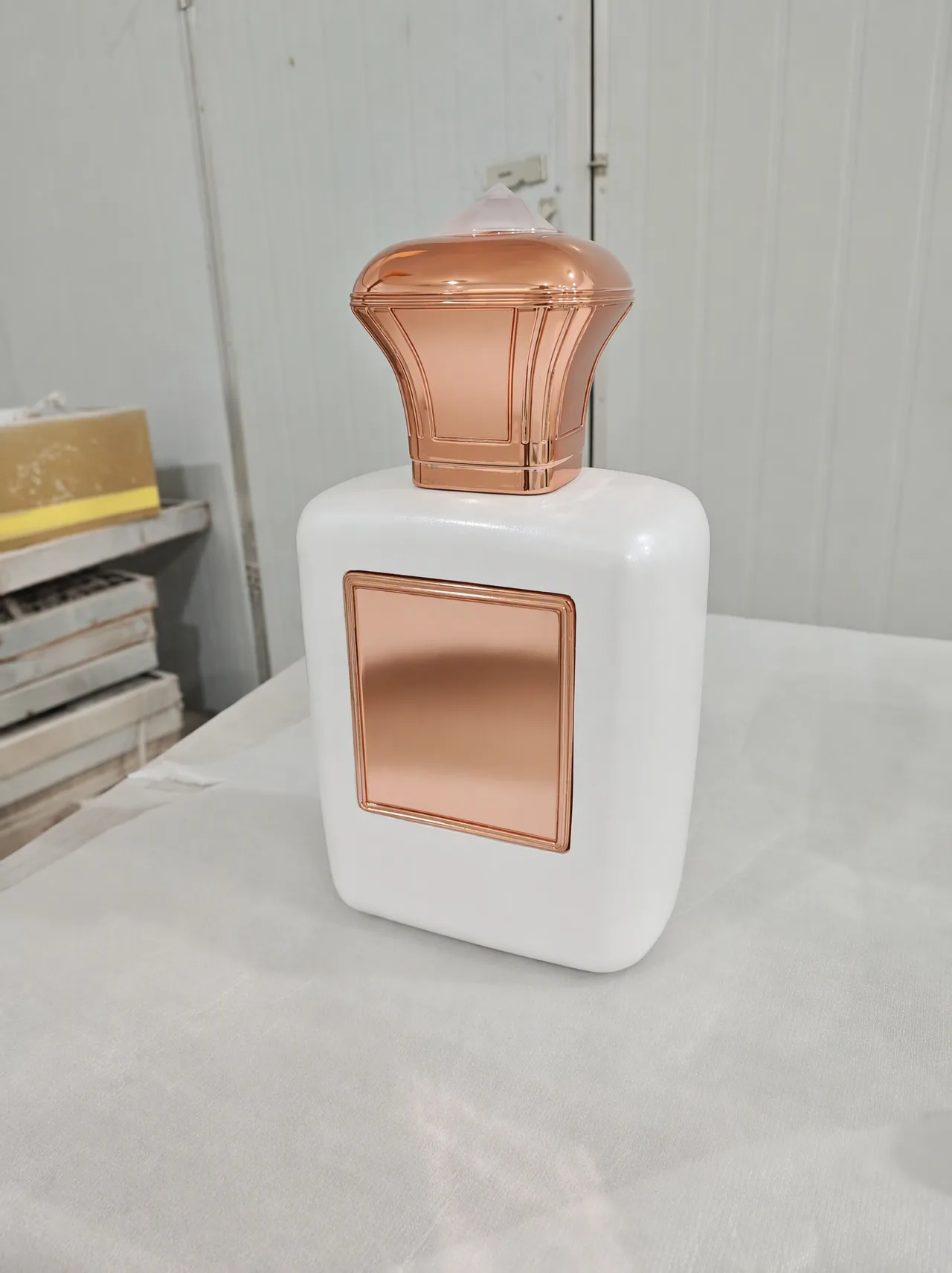
A crackle finish is judged in about ten seconds, and usually by a thumb. The buyer runs it along the shoulder, feels the film give way at each line, and then asks the question that has nothing to do with the mould: “will the second one look like this one?” That question is the whole subject of this piece. The shape is the easy half.
What the finish actually is
Two coats, in order. A colour base goes down first and is left to reach a specific state. Then a crackle coat goes over it. As that top film cures it shrinks faster than the layer beneath, and the tension pulls it apart into a network of fine splits. What you see in each split is the base colour coming back through. The finish is white here, so the contrast is low, but the mechanism does not change.
It is worth being clear about what it is not. It is not a decal, and it is not a texture cast into the mould. A moulded crack reads as a groove: light goes in and stops. Real crackle has separated, so the line reflects differently from the surface on either side of it, and that difference is what the eye reads as depth. Nor is it the crazing you find on a forty year old lacquer box, which follows the object's history. Controlled crackle is decided in the spray booth, and it can be repeated to a density.
Why the white sample photographs flat
Every buyer who has asked us for crackle white has also asked, at some point, whether we sent the right photos. We did. On a white piece the splits are a fraction of a millimetre wide and the film is white on white. Shoot it from a metre and a half under a softbox and the cracks fill with reflected light and disappear. The same process on a metallic red base is in the photo below: the underlayer throws light back up through every split, so the network shows at a glance. Same booth, same sequence, different base.
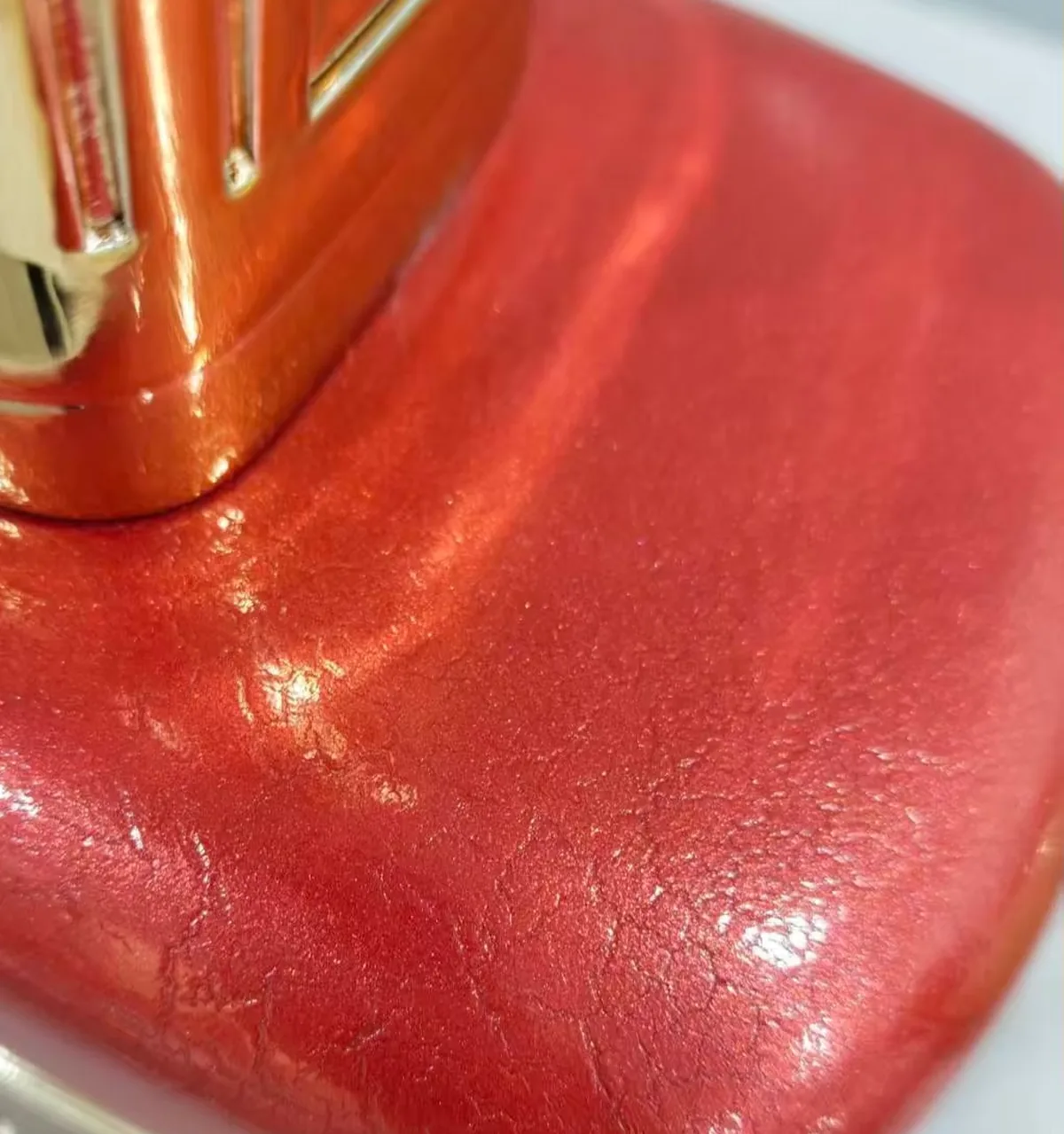
So the practical rule for approving a sample is this: do not sign off crackle from a phone photo taken from standing height. Look at the piece at 30 to 40 cm with a light held low across the surface, the way you would look along a guitar neck. That is how we inspect it, and it is why the finish photos we send are shot at that angle.
The replication problem is chemistry, not geometry
A mould gives you geometry once, and then it gives you the same geometry every time. Crackle has to happen again on every piece, and it happens differently depending on a short list of variables. How wet the crackle coat goes on is the first: a heavier coat opens wider cells, a light one may not open at all. How long the base is left before the top coat goes down is the second. Room temperature and humidity during flash-off are the third, and they are the reason we do not schedule this finish on a wet week without checking the booth.
The failures are specific, which is the useful part. No cracking at all usually means the film went on too thin or dried too slowly to build tension. Cells that run too large read as shattered glass rather than lacquer, and once they are that wide the piece is scrap. Cracks that lift at the edge are an adhesion fault and will travel. The one that catches people who have not run this finish before is density: on a curved shoulder the gun passes at a different angle and lays a different film thickness than it does on the flat of the body, so the cell pattern changes across the radius. Some gradient there is honest. A bald patch is not.
What we will and will not promise on a batch
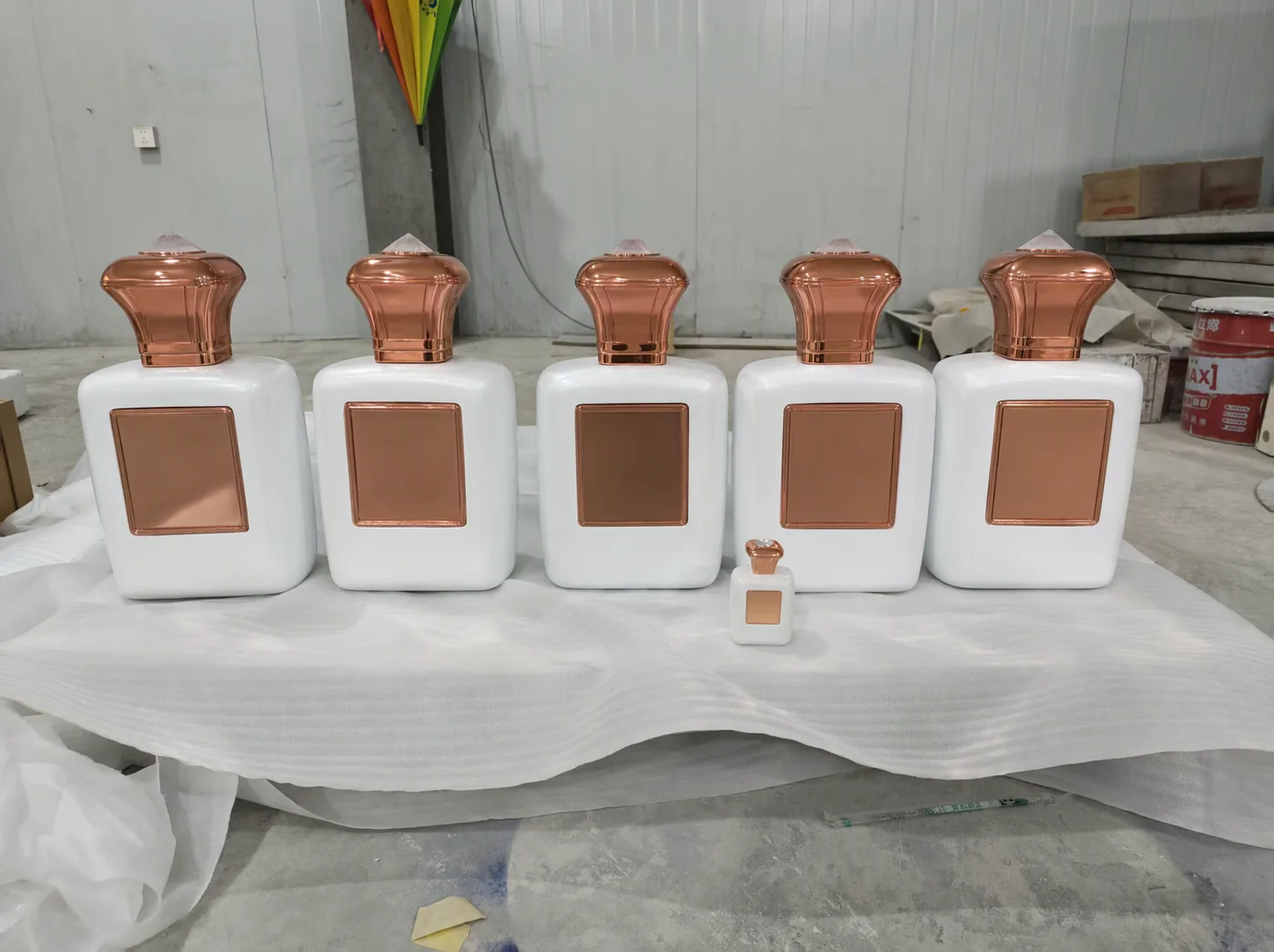
We match density and cell size. We do not match the crack map. Two pieces finished on two different days will not share a pattern, and a supplier who tells you otherwise is describing a print. For a run of five, as in the photo below, the pieces are finished in one session from one mix under one set of room conditions; that is the only reliable way to get them close. Put two of them side by side at 30 cm and you can still find where they differ. That is the honest version.
The shell underneath decides the outcome
The body is one-piece fiberglass, sanded, pinholes filled and sealed before any coating. At 0.4 m the shoulder radius is tight and the surface has nowhere to hide. A scratch that would vanish under velvet flock shows through crackle as a straight line, because the film splits along the defect instead of around it. This is why the shell is inspected under raking light before the base coat, and why we would rather rework a shell than finish over it.
Cap and plaque are separate parts
The cap is cast and plated on its own so the metal finish can be controlled independently of the body, then assembled. The plaque on this piece is polished copper-tone with a raised border, and it leaves the workshop blank. Your mark goes on site, or we apply it under written authorisation from the brand owner. That is a policy we hold on every replica, and it is also why every photo on this page shows a bare plate.
What the finish will not take
Crackle is an indoor display finish. Keep the piece out of direct sun and away from rain, and treat it as something that gets looked at rather than handled. For cleaning, a dry cloth or a soft brush is enough. Alcohol and solvent wipes will dull the film, and on a finish this thin they can re-open lines that had closed.
Adding a clear coat is possible and we usually advise against it: the lacquer fills the splits slightly, so the network softens and the piece looks varnished rather than cracked. If a piece takes a knock, a local re-finish will not match the crack density around the patch. On a 0.4 m body we redo the face instead of blending it, and that is a cost worth knowing before the crate is closed.
Specs at a glance
| Height | 0.4 m shown; built to your size |
|---|---|
| Body | One-piece fiberglass, hand-finished |
| Finish | Crackle lacquer over a matched base colour |
| Cap | Cast and plated as a separate component, polished copper tone |
| Plaque | Blank by default; finished with your mark under authorisation |
| Minimum order | from 1 piece |
| Production lead | 20-30 days, depending on order quantity |
Common questions
Can you match a crackle sample I already have?
Send the physical piece, not a photo. We match density and cell size against it and finish a test panel before the run. What we cannot do is reproduce its individual crack map, for the reason above.
Does the finish hold on a tight radius?
It holds, and the cell pattern changes across the curve because the film thickness changes. We set an acceptable range with you at the sample stage rather than promising a uniform pattern that the process cannot deliver.
Can the plaque carry our brand mark?
Yes, either applied on site by your team or by us under written authorisation. Without that authorisation the plate ships blank, including on repeat orders.
If you are weighing a crackle shell against a matte one, the comparison that matters is how the piece behaves under retail spotlights: crackle scatters a little and keeps its lines, while a deep matte like velvet flock swallows the light entirely. For larger pieces the shell build changes again, as in this 1.1 m fiberglass factice. Send us the bottle and the surface you want to end up with, and we will quote the finish as its own line item, because on this process it is one.