
2026-10-10 · 9 min read
Museum-Grade 1.2 m Prism Acrylic Perfume Bottle Display
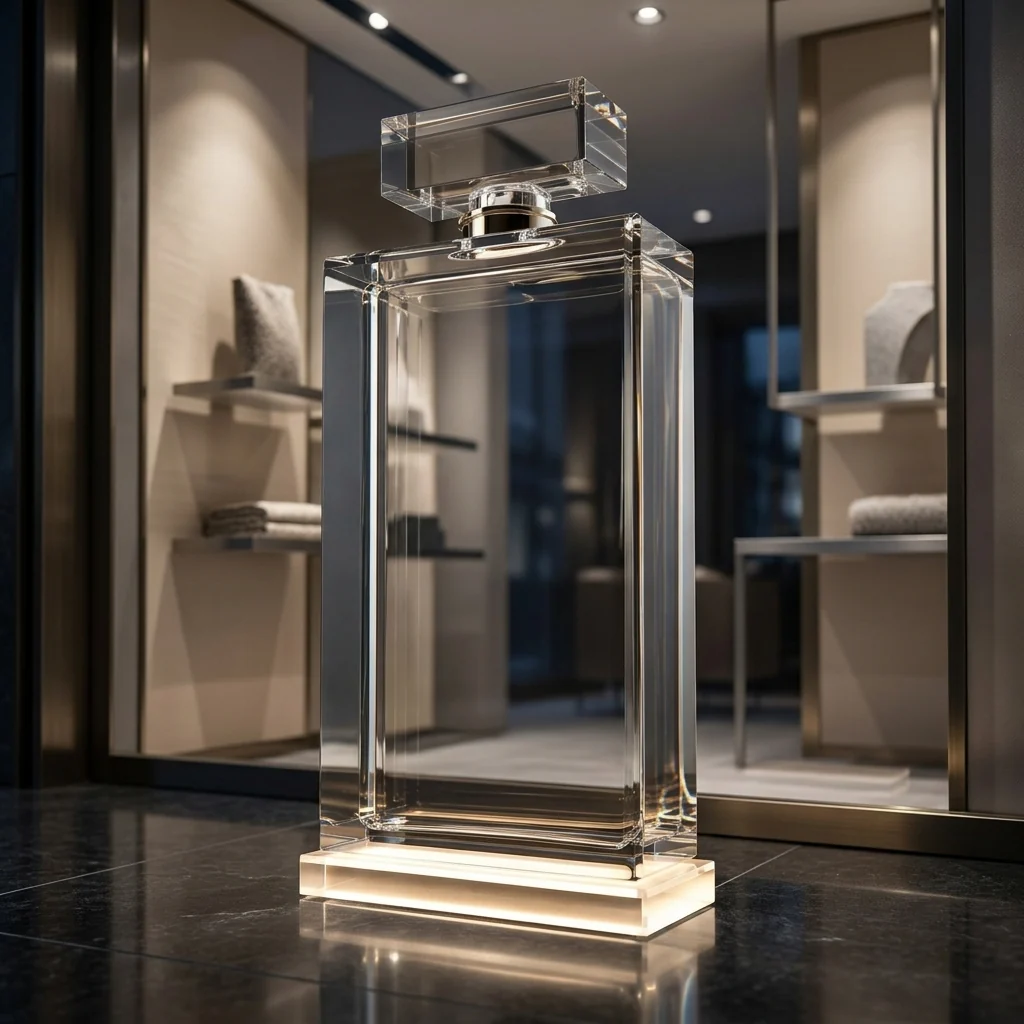
A transparent display piece this size has nowhere to hide. There is no paint to bury a bond line, no flocking to soften an edge, and no way to disguise the inside of the object, because the inside is what you are looking at. That is the whole difficulty of a 1.2 m prism acrylic perfume bottle: every decision about how it was made stays visible, at eye level, under shop lighting, for years.
What the piece actually is
This one was specified as a flagship-window and brand-museum piece rather than a counter object. The approved figures for the build are:
| Overall height | 1.2 m with base |
|---|---|
| Bottle body | 90 cm high × 30 cm wide × 12 cm deep |
| Net weight | approx. 25 kg |
| Body material | High-transparency cast acrylic, 8 mm thick |
| Cap | Acrylic cap on a stainless steel core |
| Construction | Modular three-piece: cap, body, LED base |
| Lighting | Hidden LED base, remote controlled, warm / cool white |
| Branding | Custom logo engraving; shipped blank until authorised |
| Minimum order | from 1 piece |
| Sampling | around 15 days |
Dimensions and weight above are the figures for this specification. If your own piece is going into a fixed opening, into a vitrine, or onto a floor with a load limit, treat those numbers as items to confirm on the approved drawing before production starts, not after the crate lands.
Why it is not cut from one block
The obvious way to make a clear display object is to start with a solid block and cut the shape out of it. It is also the way most of these pieces fail. A monolith at this height becomes heavy in a way that stops being a handling inconvenience and starts being a logistics problem: it will not pass a standard doorway, it will not ride in a lift, and it wants a crate that costs as much as the model. Worse, a single deep scratch on a face you cannot refinish condemns the entire object.
So the piece is built as three parts that travel separately and assemble on site — cap, body and lit base. That is not a cost shortcut dressed up as design. It is what lets every face be polished and inspected flat, on a bench, under proper light, before anything is bonded. It is also what makes the object serviceable: a chipped base can be remade without touching a body that took weeks to finish.
Cutting, edges and the reason tool marks ruin everything
Acrylic for a visible part is bought as cast sheet, not extruded, and this build runs on 8 mm sheet: heavy enough that the edges carry real optical weight and the walls read as glass rather than as a box, and light enough to hold the finished model at around 25 kg. Cast material machines and bonds more predictably, and it polishes to a deeper clarity, which matters when the material itself is the finish. Sheet arrives with a protective film that stays on for as long as possible — every time it is peeled and re-applied, the chance of a scratch under the film goes up.
Cutting leaves a rough, opaque edge, so saw cuts are made oversize and the real edge is produced afterwards, by machining and then polishing. The edge is where a transparent piece is judged: a properly worked edge goes glass-clear and picks up a bright line of light along its length, while a rushed one reads grey and slightly cloudy. Internal corners are radiused rather than cut sharp for two reasons — a sharp internal corner concentrates stress and invites a crack later, and a radius is simply easier to polish evenly, by hand, without leaving a flat spot.
Bonding: the joint you are not supposed to notice
Transparent parts are joined with a solvent cement that wicks into the gap by capillary action and welds the two faces together. The joint is strongest and least visible when the fit is tight and even, so the parts are dry-fitted and checked before any cement is introduced, and clamped so the seam does not open while the solvent flashes off.
A bad transparent bond announces itself. Where the two faces meet imperfectly, the joint line refracts light differently from the surrounding material and shows up as a bright stripe — the clearest possible signal that the piece was assembled rather than made. Air drawn in with the cement becomes permanent bubbles; dust in the gap becomes permanent specks. None of it can be sanded out afterwards, because you cannot reach the middle of a bonded seam. That is why this work is done early in the day in a clean area, and why we would rather spend an hour re-fitting parts than accept a seam that will be read at 30 cm in a boutique.
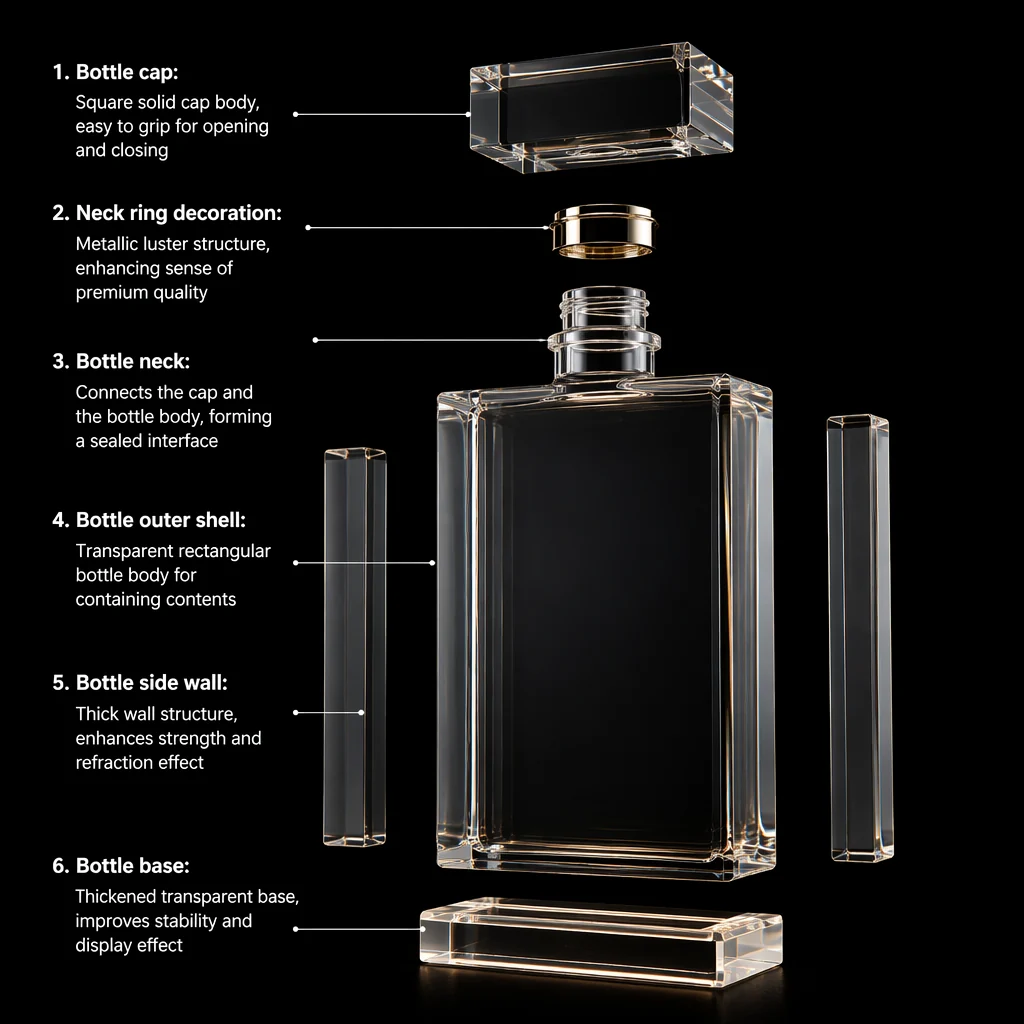
The cap, and why there is steel inside it
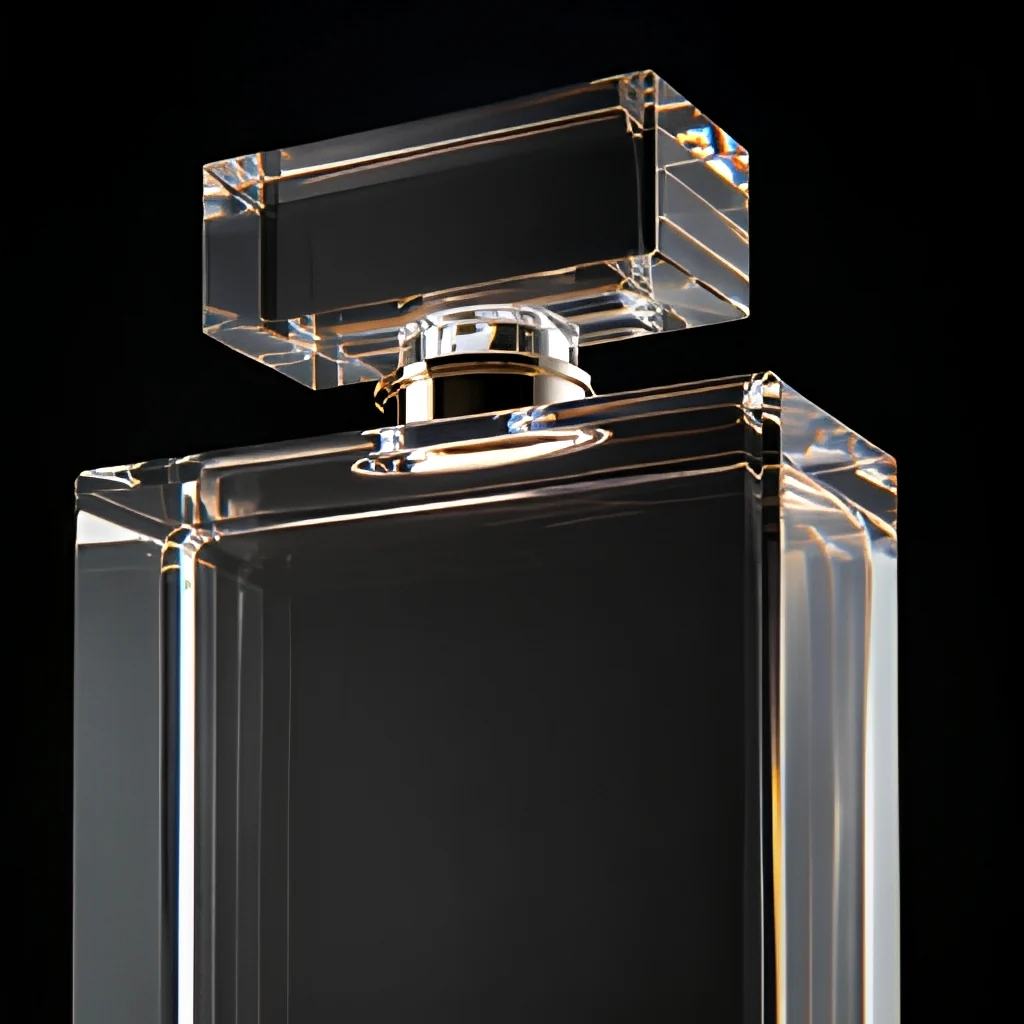
The cap is a solid-looking block of acrylic that carries a stainless steel core. The steel is not decoration — it adds mass exactly where the piece wants it, so the cap seats with a deliberate feel instead of a light, hollow click, and it gives the mounting a stable anchor that will not deform with handling or temperature.
Around the neck there is a metallic ring, and small details like this are where a scaled model either reads as a real bottle or reads as an ornament. The ring has to sit concentric with the neck, at a consistent height, with a finish that matches the cap rather than fighting it. Getting the cap to drop on and come off with the same feel every time is a tolerance question, and it is settled at the drawing stage, not by trimming parts during final assembly.
Hiding the light source
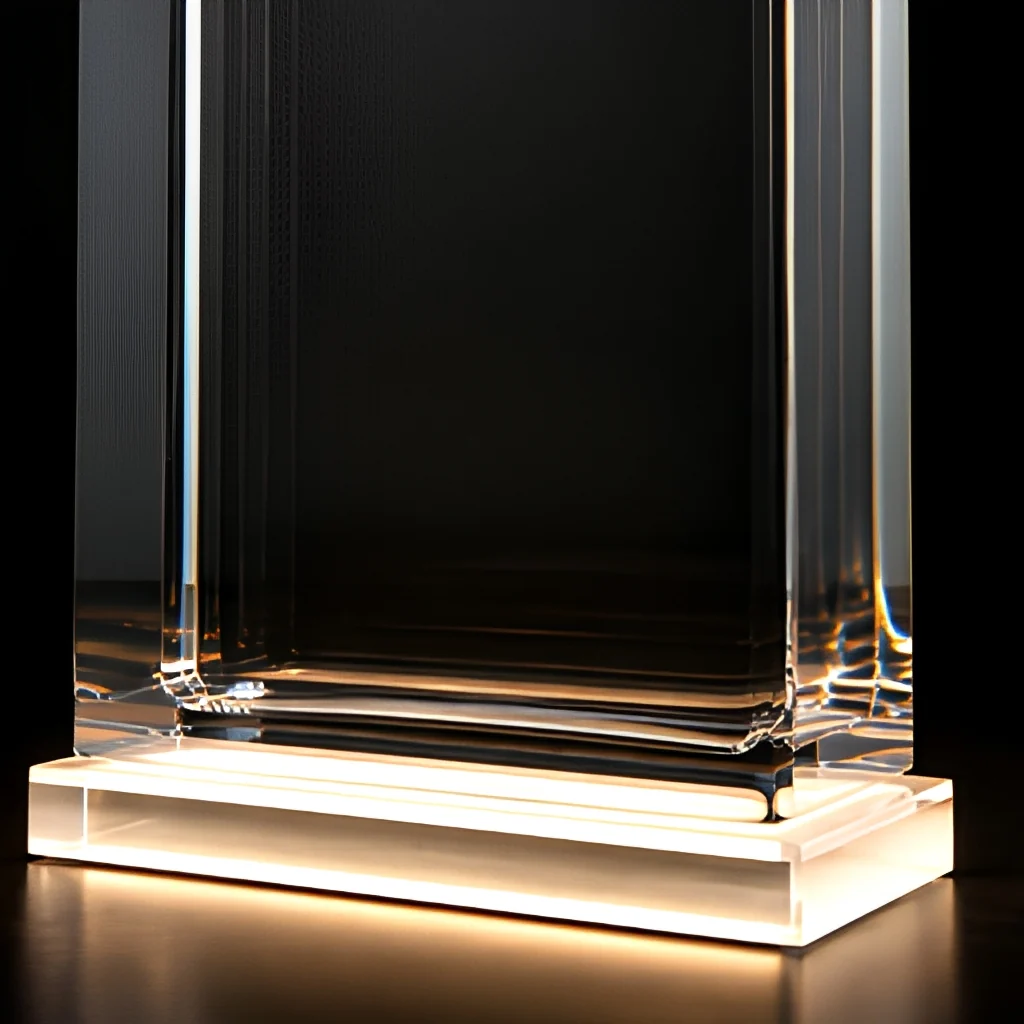
The base is lit, and the first rule of the lighting is that you never see where it comes from. The emitters sit inside the base, and the light reaches the eye after passing through the acrylic — which is also what makes the base glow rather than glare. Uniformity across a 30 cm face is the part that takes tuning: a single bright spot is immediately obvious and immediately cheap-looking.
Warm and cool white are both available, and that is not a gimmick. The same model may stand in a warm boutique interior in one market and a cool, daylit department-store hall in another, and the base light has to sit in that room rather than fight it. Control is by remote, which is a small decision with real consequences: nobody should be crouching behind a 25 kg object to reach a switch on the floor, and a piece in a locked window unit should not need to be moved to be turned on.
What “museum-grade” means in this workshop
We use the term as a build standard, not as a certificate, and it is worth saying plainly what it buys you. A museum piece is looked at from close range, for a long time, by people who are not in a hurry. That sets four requirements above ordinary retail work:
- Nothing visible that should not be. No fasteners on show, no tool marks on a polished face, no visible light source, no seam you can find by eye at the intended viewing distance.
- Nothing that changes with the room. The surface has to behave under raking light, under spots and under daylight, because you cannot control the light where the piece finally stands.
- Nothing that depends on a good day. Parts that are dimensional rather than fitted, so a cap seats identically in Shanghai and in the venue, and so a replacement part can be made from the drawing months later.
- Handling treated as part of the design. Where people touch the piece, how it is cleaned, which cloth is safe on the surface, and how it is packed for a second move rather than only the first.
That last point is the one clients underrate. A display piece usually travels more than once in its life — launch, then archive, then a new window — and the packing that gets it through one delivery is not necessarily the packing that gets it through four.
Moving it, and standing it up
The three-part split is what makes the freight practical, but it moves the risk to the assembly step, so that step is planned rather than improvised. The base carries the load and has to sit on something genuinely level; a 1.2 m object on an unlevel floor is a leaning object, and a leaning clear object looks broken. The body is handled with gloves, because a fingermark on cast acrylic at eye level is a service call, and the protective film comes off at the end of the process rather than the beginning.
Tell us the destination and how the piece will be installed — a store your own team fits out, a museum with an installation window, or a venue that will not let anyone on site early — and the crate and the assembly instructions get written for that situation.
Artwork and engraving
Engraving is available and is cut to your approved file, so what you sign off is what appears on the surface. The piece ships blank by default. We build display models of packaging you own or are authorised to reproduce, and we ask for that to be confirmed before work starts rather than afterwards — which is also the arrangement that lets a brand use these pieces in public.
Common questions on clear acrylic display models
Why is the 1.2 m display built in three pieces instead of one?
Weight and risk. A solid block of this height would be far heavier, would not pass a standard door or lift, and would be scrap if one face were damaged. Three parts stay transportable, every face can be polished and inspected flat, and a damaged part can be remade without rebuilding the whole model.
Is the LED base controlled remotely, and why does that matter?
Yes. The emitters sit inside the base, so no light source is visible from a normal viewing angle, and warm and cool white are both available to suit the room. Remote control means nobody has to reach under a 25 kg object to switch it on.
Can our logo be engraved on the acrylic?
Yes, to your approved artwork, and the model ships blank until you confirm the rights. Minimum order is from 1 piece, and sampling takes around 15 days.
Planning a flagship window or a brand archive piece? See thefactice perfume bottle range, orsend us your bottle, the target height and the room it will stand in and we will come back on feasibility, materials and cost.