2026-10-04 · 8 min read
Scaling a Cosmetic Bottle to 1.52 m Without Losing the Details
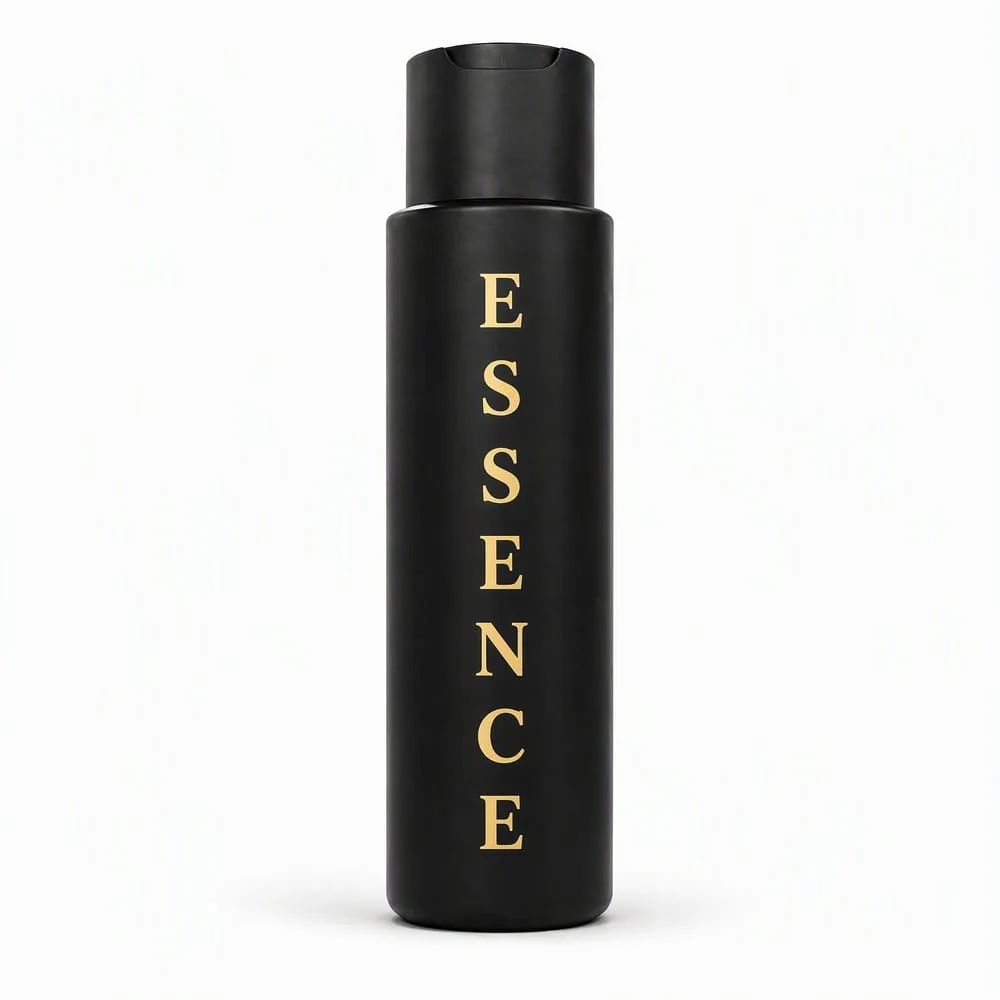
A bottle that looks clean and simple at hand size becomes unforgiving at 1.52 metres. The cap opening is now at eye level. A shallow shoulder looks flat. A label that is a few degrees out can be seen from the other side of the shop. This acrylic display model was built to keep those small relationships intact while giving the original pack enough scale to work as a window or exhibition piece.
The job is enlargement, not redesign
The starting point is the customer’s actual container. We record the overall height and width, but those two numbers are not enough. The body radius, the amount of taper, the shoulder height, the gap beneath the cap and the cap’s recessed opening all need their own measurements. On this bottle, the transition between the cylindrical body and the wider cap is part of its character. If that step is moved or softened, the replica no longer reads as the same pack.
We scan the sample and prepare a technical drawing from the captured geometry. The target height is then applied as one scale factor across the model. We do not stretch the body until it looks about right and then make the cap fit. Body, cap and artwork are checked against the same set of reference lines before fabrication starts.
What “exact scale” means in the workshop
Exact scale does not mean copying one overall dimension. It means preserving the ratios that make the package recognisable. We compare the drawing and the sample at the front, side and three-quarter views, because an error that disappears in the front view often shows up immediately from the side. For a tall cylindrical bottle, the useful checkpoints include:
- body width against total height;
- cap diameter and cap height against the shoulder;
- the depth and width of the flip-top finger recess;
- corner and edge radii where one surface meets another;
- the start, finish and centreline of the vertical artwork.
These checkpoints are put on the approval drawing. That gives the client something measurable to sign off and gives the workshop a reference during assembly. It also avoids an expensive argument at the end about whether a curve “feels” right.
The flip-top cap is not a plain cylinder
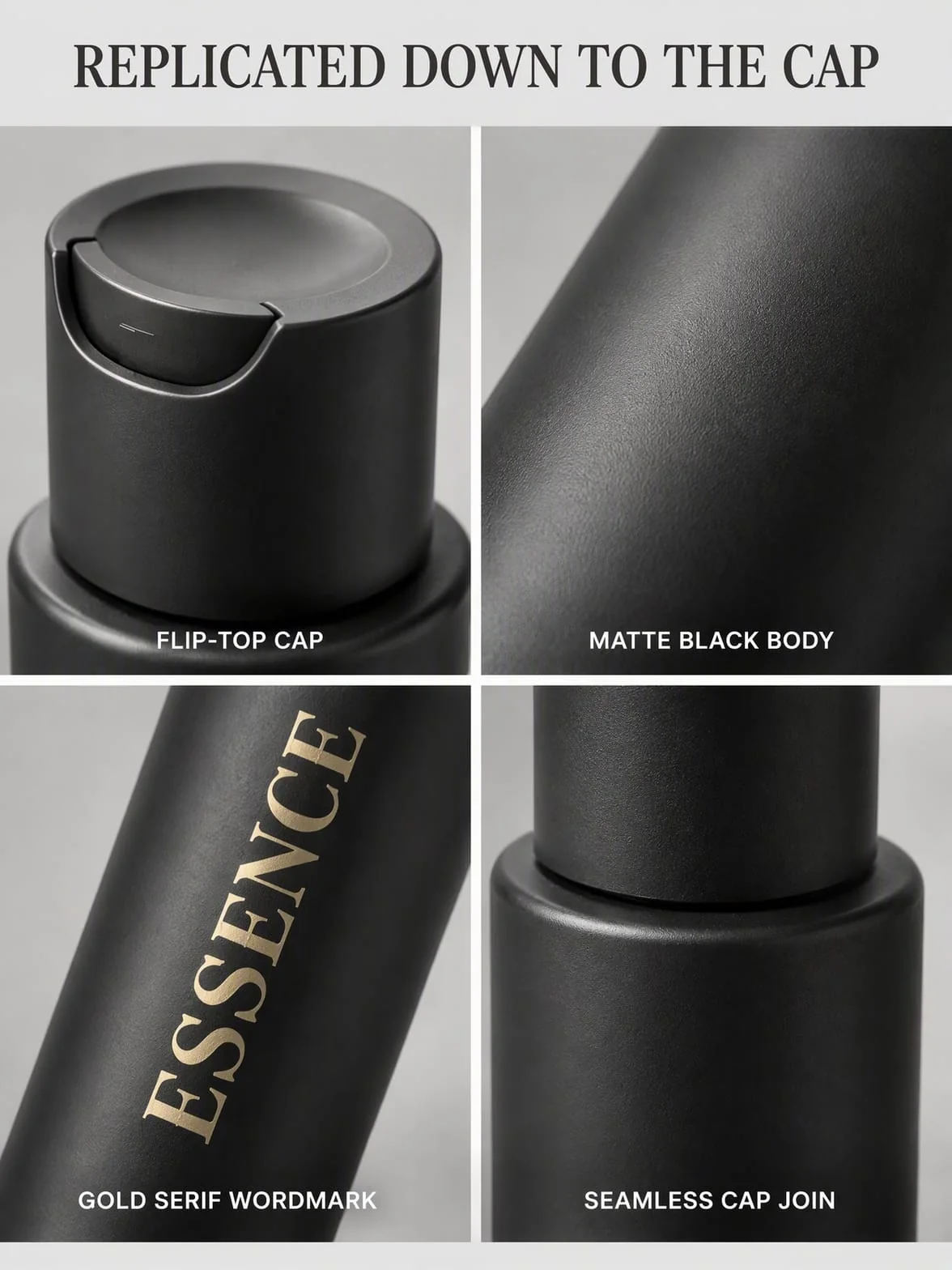
From a few metres away the cap looks simple. Up close, the shallow finger recess, the lid line and the softened top edge do most of the work. If the recess is too deep, it looks like a handle. If it is too shallow, it disappears under shop lighting. The opening therefore follows the scan rather than a generic cap profile.
The cap and body are handled as separate parts so their edges can be finished cleanly. During the dry fit we check the joint all the way around, not just at the front. A neat front photograph can hide a gap at the back; a retail piece cannot.
A matte finish still has to be even
Matte black is useful in a shop because it controls glare and lets light-coloured artwork read from a distance. It is also less forgiving during finishing. A change in texture across a panel appears as a change in colour, and a sanding mark catches side light even when the colour match is correct. The surface is therefore checked under raking light before the final coating is accepted.
Acrylic suits this straight-sided build because it gives us a stable body and clean edges. Material choice is not automatic for every large replica: deep compound curves or models that will take hard handling may call for fiberglass or resin instead. We choose the construction after seeing the geometry, finish and installation plan, not from height alone.
Artwork has to be rebuilt for the large surface
Enlarging a small label file by a percentage is rarely enough. Letter spacing, line thickness and the relationship between the artwork and the bottle edges all change when the piece is viewed from several metres away. For this model, the vertical lettering was positioned from a centreline and checked against the shoulder and base rather than placed by eye.
Final branding is applied only from artwork supplied or approved by the customer. For public case material we use de-identified artwork and withhold client names. The same geometry can carry the customer’s authorised logo, label or a blank finish for local installation.
How we check the finished replica
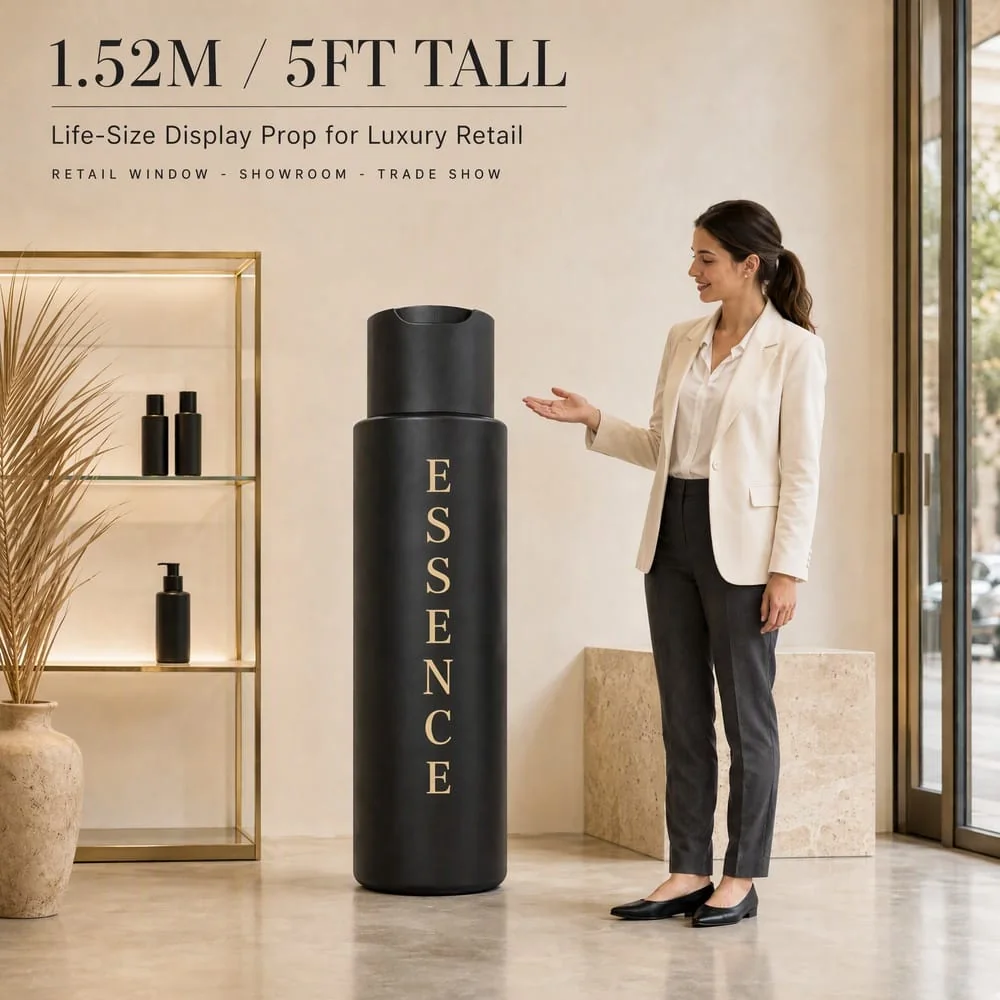
Final QC returns to the same reference points used in the drawing. We check overall height, body width, cap position, the opening profile, surface consistency and artwork alignment. The model is then photographed from the front, side and at an angle. The angled view matters: it shows whether the cap sits square and whether the body keeps the same silhouette from top to bottom.
A piece this size is packed as an object, not as signage. The cap, corners and printed face are protected against movement, with cushioning inside an export wooden case. Access routes at the destination should be checked before the case is built; a five-foot bottle is manageable, but the packed case needs more clearance than the model itself.
Case specification
| Finished height | 1.52 m / 5 ft |
|---|---|
| Material | Acrylic |
| Finish | Matte black |
| Cap | Scale-matched flip-top form with recessed opening |
| Artwork | Customer-approved logo or label; de-identified treatment shown |
| Use | Retail window, showroom, event and trade show display |
| Minimum order | from 1 piece |
| Production | This case was recorded at 20–30 days after design confirmation; current timing is confirmed with the quotation |
| Packing | Cushioned export wooden case |
What to send for an accurate quote
- the physical bottle, CAD data or dimensioned drawings;
- the target height and where the model will be viewed;
- finish references under the intended lighting;
- authorised artwork files and the required placement;
- the delivery address, access limits and event deadline.
If you are planning a large-format bottle, start with the object rather than a mood board. Send us the sample, drawing and target height, and we will confirm the practical material, construction and approval points. You can also review our giant cosmetic replica models or see how a job moves through the custom production process.