
2026-10-21 · 8 min read
How to Pack and Ship Oversized Display Props
A 2 m display bottle rarely fails on the show floor. It fails somewhere between the workshop door and the stand: on a pallet, in a warehouse, with a forklift driver who has ninety seconds to move it and no idea what is inside the crate.
We build factice perfume bottle models and display props between 0.4 m and 2 m high, and the crate is part of that work. What follows is the sequence we go through before a finished piece leaves the building, including the parts that are decided long before anyone looks at a freight quote.
Decide the break-down before the body is laid up
Whether a piece travels in one crate or four is a drawing decision. Made after painting, it becomes a repair: a joint cut into a finished surface reads as damage, while a joint designed in reads as a panel line the client approved in advance.
Two limits force the answer. Can two people lift the crated piece, and will the crate pass every door on the route — the workshop door, the container or aircraft pallet, the venue service corridor, the goods lift. Below roughly 1.1 m, most pieces travel whole. Above that the piece is built in sections with keyed joints, and the assembly sequence travels in the crate with the hardware.
We would rather ship three sections that fit a lift than one object that has to be walked up a staircase at the venue.
What actually moves inside a crate
A crate that survives the voyage can still ruin a piece through 5 mm of movement in the wrong place. Four failures are worth designing against, because they account for most of the claims we see on this type of work:
- Edge chipping on acrylic. A cast acrylic panel chips at a corner before it cracks anywhere else, so corners get solid blocking rather than soft foam.
- Paint rub on matte and flocked surfaces. Flocking burnishes where anything moves against it and the mark does not come out. Contact points are padded and the gap is held rigid; a loose fill of foam only relocates the rubbing.
- Cap shear. A tall sculpted cap is a lever. The neck is braced back to the crate wall so the cap cannot carry its own mass through a hard brake.
- Base corner crush. The base is usually the heaviest part and the part the crate lands on, so it sits on a skid rather than on the crate floor.
Straps go over padding, never straight over a finished surface. For sea freight a desiccant pack goes in and the crate is lined, because a closed container crossing the tropics will condense moisture on cold acrylic.
Wood, heat treatment, and the stamp a broker looks for
Solid-wood crates, pallets and dunnage are regulated packaging. Under ISPM 15 the wood has to reach a 56 °C core temperature for at least 30 minutes and carry the IPPC mark, stamped into the wood itself. Processed board such as plywood is handled differently in most markets because it is no longer raw wood.
The failure here is quiet and expensive. An unstamped solid-wood crate can be held, fumigated or returned at the destination, and the importer pays for whichever happens. If your own exhibit house builds the crate, ask for the mark before it is closed, not at the port.
Sea, air or courier: choose by date, not by price
| Mode | Fits | Trade-off |
|---|---|---|
| Sea LCL | One to three crates, 0.4–1.1 m pieces, no hard deadline | Lowest cost per piece; the crate is handled at both ports and again at the consolidation warehouse, so every extra contact is a chance to drop it |
| Sea FCL | A multi-piece installation, or several venues supplied together | Fewer handlings, and you pay for the container whether it is full or not |
| Air freight | Show dates that ocean cannot make, compact life-size models | Priced on chargeable weight, and a fiberglass body is mostly air inside a large volume |
| Courier | 1:1 mockups, samples, one small counter piece | Size and weight caps, and the parcel is sorted by machine rather than by hand |
Air is not automatically faster end to end. The piece still has to be collected, screened and cleared, and a crate built for a ship is not built for an aircraft pallet. If a show date is the real constraint, the mode should be chosen before sampling starts, while there is still room to change the break-down.
The last mile is where budgets leak
Freight quotes usually stop at the airport or the port. The costs that surprise buyers sit after that point: terminal handling, brokerage, a liftgate because a 1.4 m crate does not come off a standard van, a delivery appointment inside a fixed build-up window, and storage if the crate arrives before the venue will accept it.
Delivery terms decide who absorbs those. DAP leaves import clearance and local delivery with you. DDP puts them on the shipper, which is why DDP quotes come back higher and why some forwarders decline them on one-off crates. Settle it in writing before the crate is closed, and name the person who unpacks: a piece unpacked on a loading dock has already been handled twice more than it needed to be.
One boundary worth stating
We build the piece and the crate, document what is inside, and hand it to the forwarder you or we appoint. We do not control vessel space, port congestion or a customs inspection, and no maker can promise a delivery date that depends on them. What we can control is the crate, the documents and whether the piece arrives able to be assembled by the people on site.
What to send us before we quote freight
- the full destination address, with the postcode;
- whether it is a business with a dock or a venue with a build-up window;
- finished height and approximate weight of the piece;
- the date it has to be on site, and the date it can be collected;
- DAP or DDP, and who clears customs;
- who assembles it, and whether they need tools supplied in the crate.
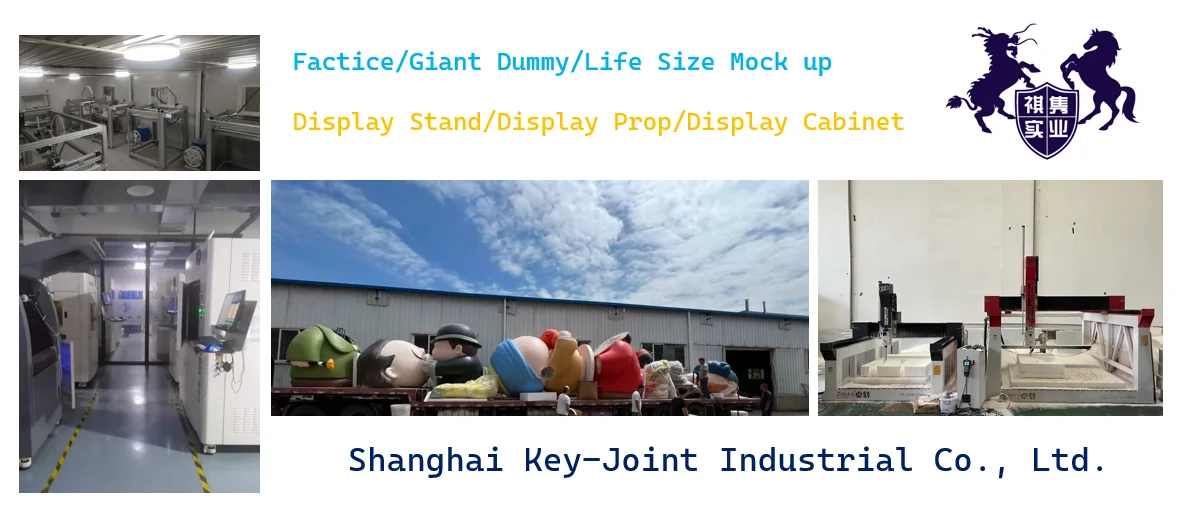
Minimum order is from 1 piece, and sampling takes around 15 days. If you already know the destination and the installation date, send both with the piece dimensions through ourcontact page and we will quote the build and the crating together. Thecustom display props page shows the plinths, counters and oversized models this crating applies to.
Common questions
Can we order a single piece, or is there a minimum for freight?
Minimum order is from 1 piece. A single crated piece ships as a one-off; the freight cost per unit is simply higher than it would be for several pieces on the same booking.
How long does sampling take before freight can be booked?
Sampling takes around 15 days. Booking follows sample approval and finish sign-off, because the crate dimensions are taken from the finished piece rather than from the drawing.
Do fiberglass display props need heat-treated wood crates?
Solid-wood crates, pallets and dunnage are regulated packaging under ISPM 15: the wood must reach a 56 °C core temperature for at least 30 minutes and carry the IPPC mark. Processed board such as plywood is treated differently in most markets. Either way, an unstamped crate can be refused, fumigated or returned at the destination, and that cost falls on the importer.
Building for a show? Thetrade show display props buyer's guidecovers booth rules, drayage and build-up, which is where this article stops.