
2026-11-03 · 9 min read
Clear Acrylic Factice with a Silver-Plated Cap
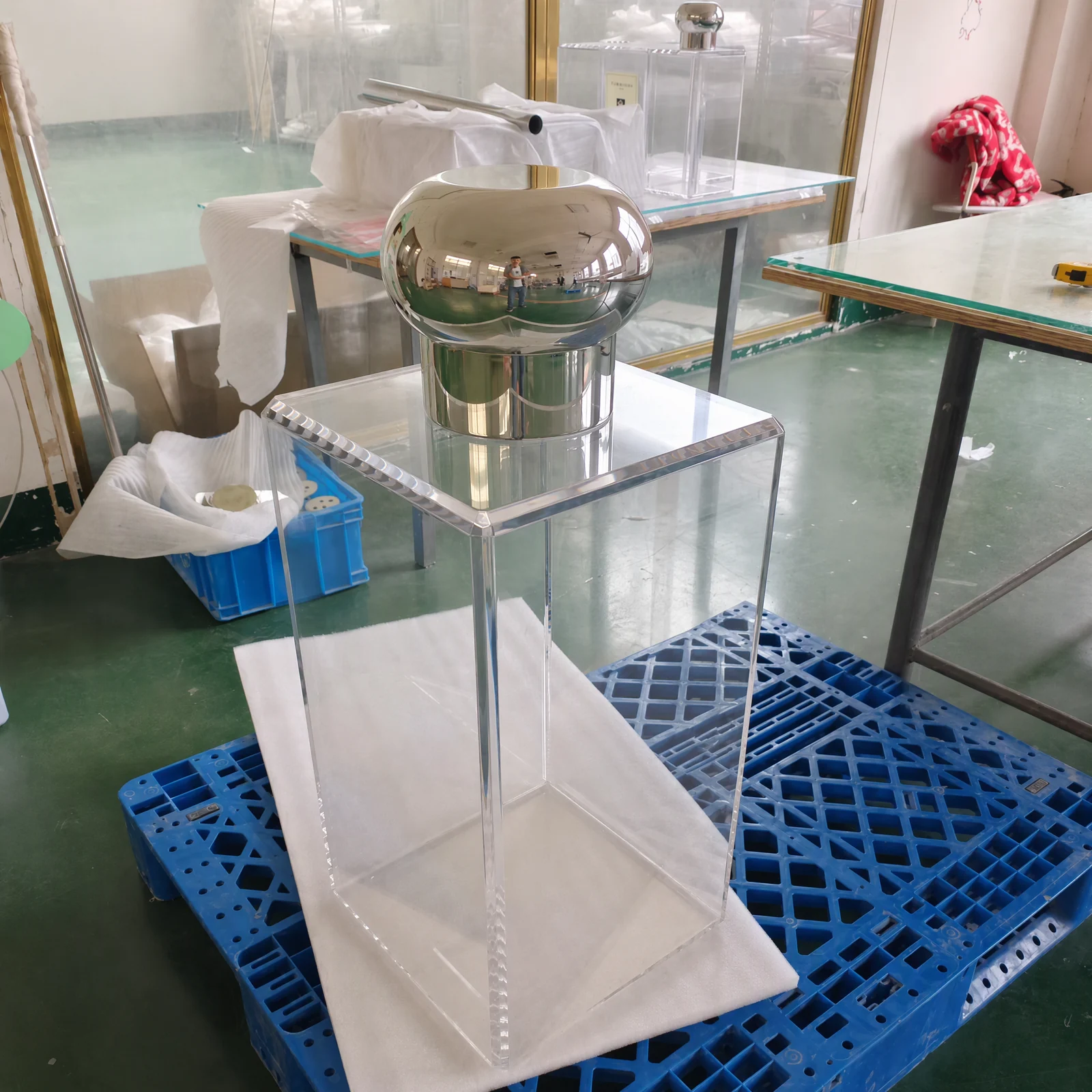
Clear acrylic records the order of work. A saw mark stays visible. A bubble in a bonded corner stays visible. A polishing wheel that dwells too long leaves heat in the edge, and the edge tells you. On this 865 mm perfume-bottle factice, the body and the warm-silver electro-plated cap had to survive the same inspection for different reasons: the body was judged through, while the cap was judged by reflection.
Start with the drawing, not the photograph
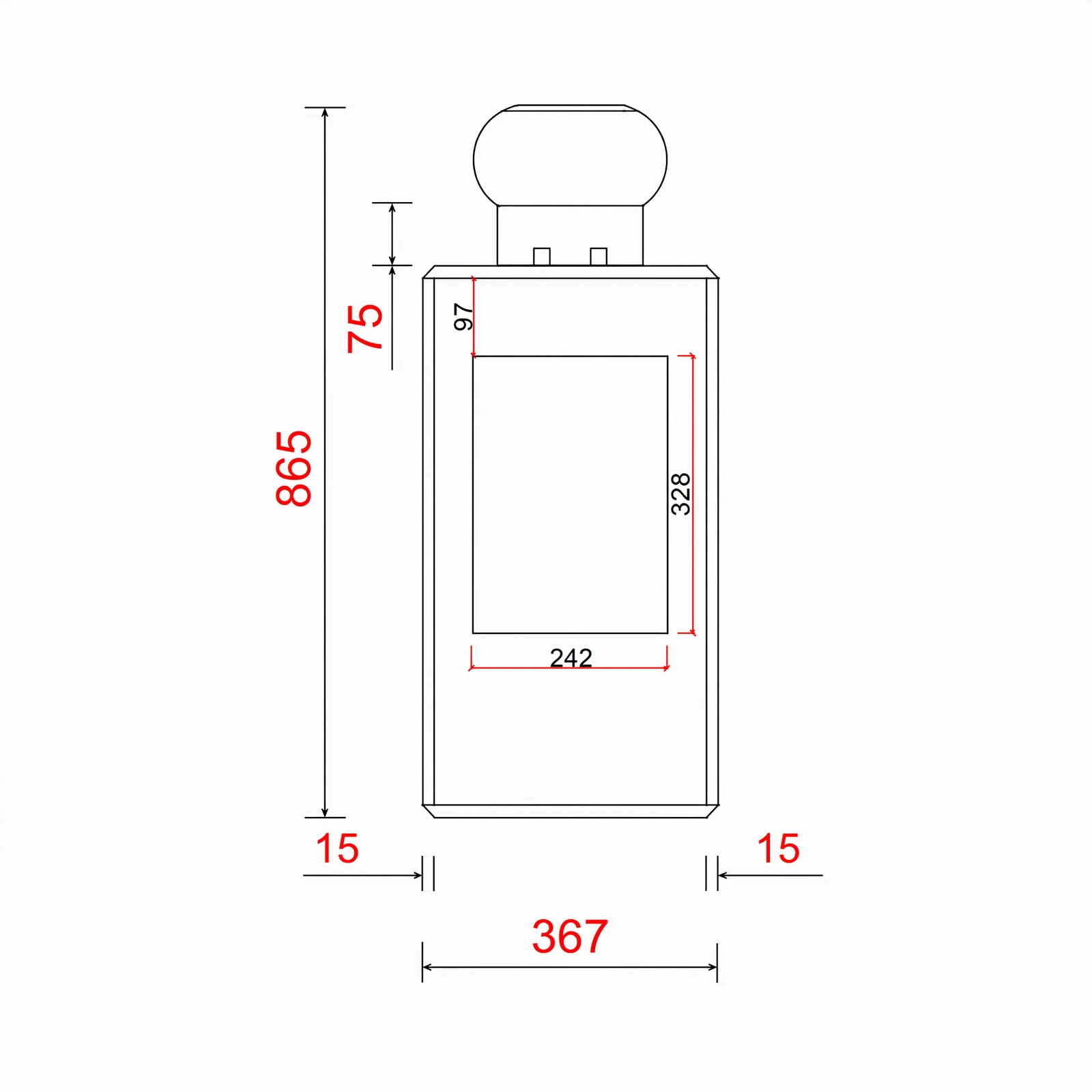
The reference bottle can be measured and, where the form requires it, captured for 3D development. That model is then reduced to parts that can actually be made. The approved drawing for this piece records an overall height of 865 mm and a body width of 367 mm. The front artwork field is 242 × 328 mm. Both side allowances are marked at 15 mm.
Those figures are not decoration on a proposal. They decide where the vertical bonds sit, how much flat area remains around the artwork, and whether the top panel can carry the neck and cap without looking pinched. Change the label size after the panels are cut and the margins stop agreeing. On transparent work, that error is visible before anyone reads the label.
The acrylic body is a sequence of edges
This is a panel-built body, not a solid block. Clear acrylic is cut slightly proud, machined to the drawing, and dry-fitted before adhesive is introduced. Dry fitting does two jobs: it proves that the top and base are square, and it shows whether the vertical edges meet continuously. Adhesive cannot correct a gap without making that gap more obvious.
Bonding is controlled by fit and cleanliness. A tight joint draws the cement along the seam. A loose joint draws air with it. The first can settle into a narrow optical line; the second leaves bright bubbles that cannot be reached after assembly. Dust is just as final. It becomes part of the joint.
Edge work follows cutting. The machined edge is progressively finished until it passes light rather than scattering it grey. The protective film stays on the broad faces during most of this work. Remove it early and every handling step becomes a scratch risk; leave it trapped under a bond and the joint has to be made again. There is no useful middle ground.
What the visible seam tells us
A transparent panel joint does not vanish in every light. The honest target is a straight, clean seam with no trapped contamination and no waviness, not a promise that four panels will look like one poured block. The workshop photograph shows the front corners clearly. That is useful evidence: the edges are polished, the panel remains flat, and the construction is readable without becoming untidy.
This method also sets a boundary. If a brief requires compound curves with no panel lines, a fabricated acrylic box is the wrong answer. The material or forming route must change. For a rectangular fragrance bottle, panel construction keeps the faces optically flat and gives the artwork a stable plane.
The warm-silver electro-plated cap
The cap is the opposite surface problem. Acrylic asks whether light can pass through cleanly. A plated cap asks whether light returns as one continuous reflection. The listing record for this piece specifies a warm-silver electro-plated bottle cap, and the workshop photographs show the intended mirror effect on the spherical top and neck collar.
Plating quality begins before the metal finish is applied. The cap substrate has to be shaped, filled and sanded until its curve is continuous. A shallow low spot may disappear under matte paint; under a mirror finish it comes back as a bent reflection. The prepared surface then receives the coating system required for the metallic layer to adhere. Final inspection is done under moving light and by watching straight workshop lines travel across the cap. A broken line means the substrate or coating still needs work.
Warm silver is a colour decision as well as a process description. It avoids the blue cast of a colder chrome appearance, but the approved tone still has to be checked beside the actual retail lighting and artwork. A cap accepted under daylight can read differently under warm spotlights.
Assembly puts two tolerances together
The neck collar sits on the clear top panel, so the plated assembly has to land centrally without loading an acrylic edge. The cap can be visually perfect and still fail the build if its collar is off-centre. The body can be square and still fail if the neck opening was taken from an early drawing. We check these as one assembly before the protective film comes off.
The mirror finish is handled with gloves from this point. Fingerprints are easy to remove once; repeated wiping with a general-purpose abrasive cleaner is a different matter. This is a display finish, not an outdoor handrail finish. Cleaning instructions should travel with the piece.
What a buyer should approve
Before cutting or plating starts, the useful approval set is short:
- overall height, body width and depth on a dimensioned drawing;
- the artwork field and its margins, not only a loose label file;
- the acceptable location and appearance of acrylic bond lines;
- a plated colour reference viewed under the intended lighting; and
- whether the cap is removable, fixed, or needs a concealed service connection.
The documented model is 865 mm high. Other sizes change the panel spans, cap support and packing method, so they are redrawn rather than enlarged from a photograph. For a related material decision, see our workshop comparison of acrylic and fiberglass for giant display props. You can also review the factice perfume bottle range before sending a brief.
Common questions
Why are the seams still visible?
Because the body is assembled from clear acrylic panels. Accurate machining, dry fitting, controlled bonding and polishing reduce the seam's visual weight. They do not turn a fabricated body into a solid cast block.
Is the silver cap suitable for constant handling?
It is intended as a display finish. The mirror surface shows fingerprints and abrasive cleaning marks. Tell us how often staff will move or wipe the piece so the cleaning and handling method can be agreed.
Can the dimensions and artwork be changed?
Yes. The drawing shown here documents one 865 mm build. Production dimensions and artwork are approved for each project. Minimum order is from 1 piece, and sampling is around 15 days.
Send the bottle or approved 3D file, target height, artwork and one cap-finish reference through thecontact form. We will return the questions that affect construction before quoting.