
2026-10-12 · 8 min read
Custom Resin Shell Display Stand: Pearl Finish, Hinged Lid
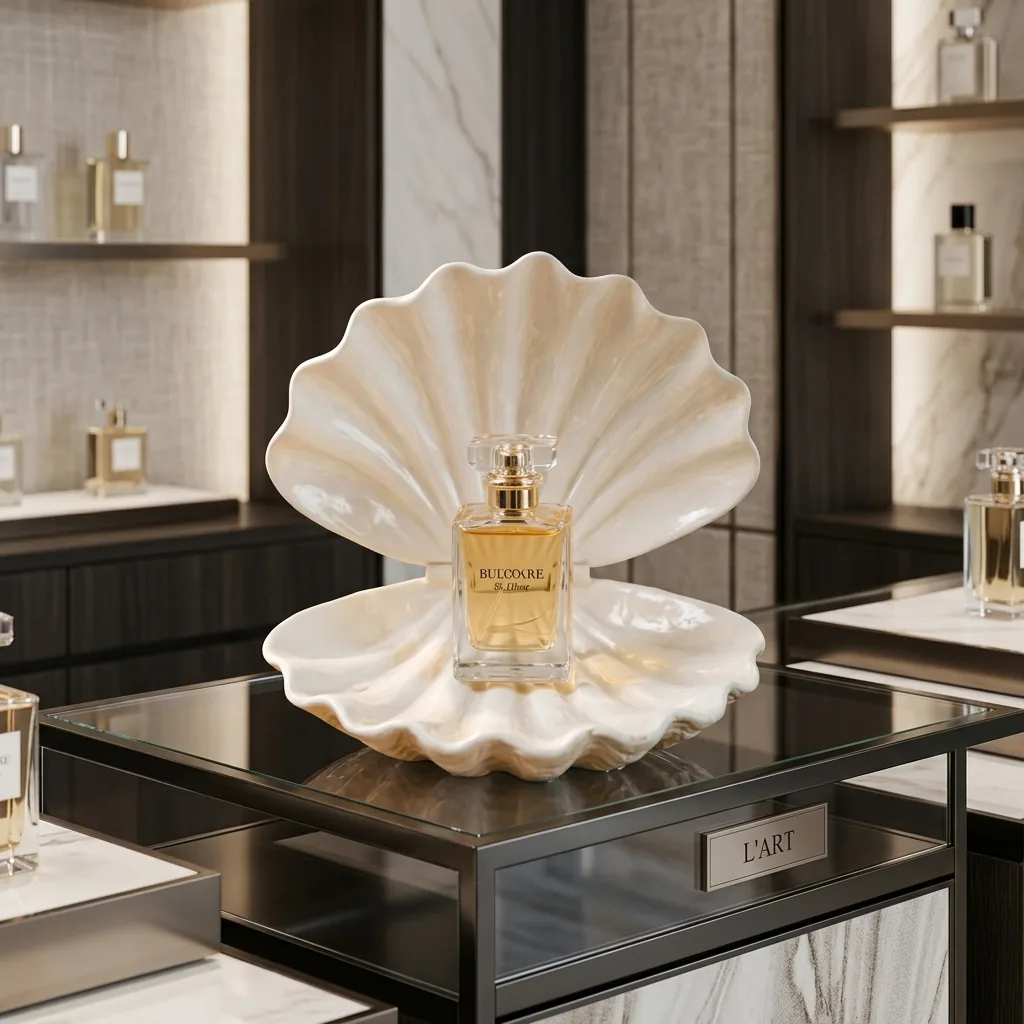
A shell that opens has one job to do before anything else. The two halves have to meet. Not nearly meet. Meet, along a rim that is scalloped, curved in two directions at once, and already finished by the time anyone finds out whether it fits.
This one came in as a window brief: a display stand shaped like a scallop shell, hinged through the middle so it opens like a clamshell. The lower leaf lies flat and carries the product. The upper leaf stands behind it as a backdrop. The surface had to read as the inside of a real shell, so a pearl effect rather than a flat white. Size, colour and rib pattern were all pencilled in as to be confirmed, which in practice means the drawing does that work later.
We build pieces like this in resin. What follows is what the material, the hinge and the pearl finish each cost you in production, and what we need from you before a drawing is worth making.
What the piece is
Two moulded leaves, a hinge let into a flat pad at the centre, and a finish that has to survive being looked at from thirty centimetres. The reference build on our drawing is a three-quarter-size scallop: 25 cm wide, with the lower leaf reaching 20 cm forward and the back leaf standing 25 cm above the hinge.
| Form | Scallop shell, hinged through the middle, opening flat |
|---|---|
| Reference size | 0.25 m wide × 0.20 m deep, back leaf 0.25 m high |
| Material | Resin |
| Surface | Pearl / pearlescent, matched to a reference |
| Colour | Made to order |
| Shape | Shell species, rib count and rib spacing all variable |
| Sizes | Made to order, up or down from the reference |
| Minimum order | from 1 piece |
| Sampling | around 15 days |
Resin, rather than fibreglass or acrylic, is the honest answer for a form like this. The piece is small, it will be handled, and the ribs are shallow. Resin takes a fine mould impression without the surface sinking between the ribs, and it takes a pearl coat cleanly. At larger sizes that calculation changes, which is why our taller display models end up in other materials.
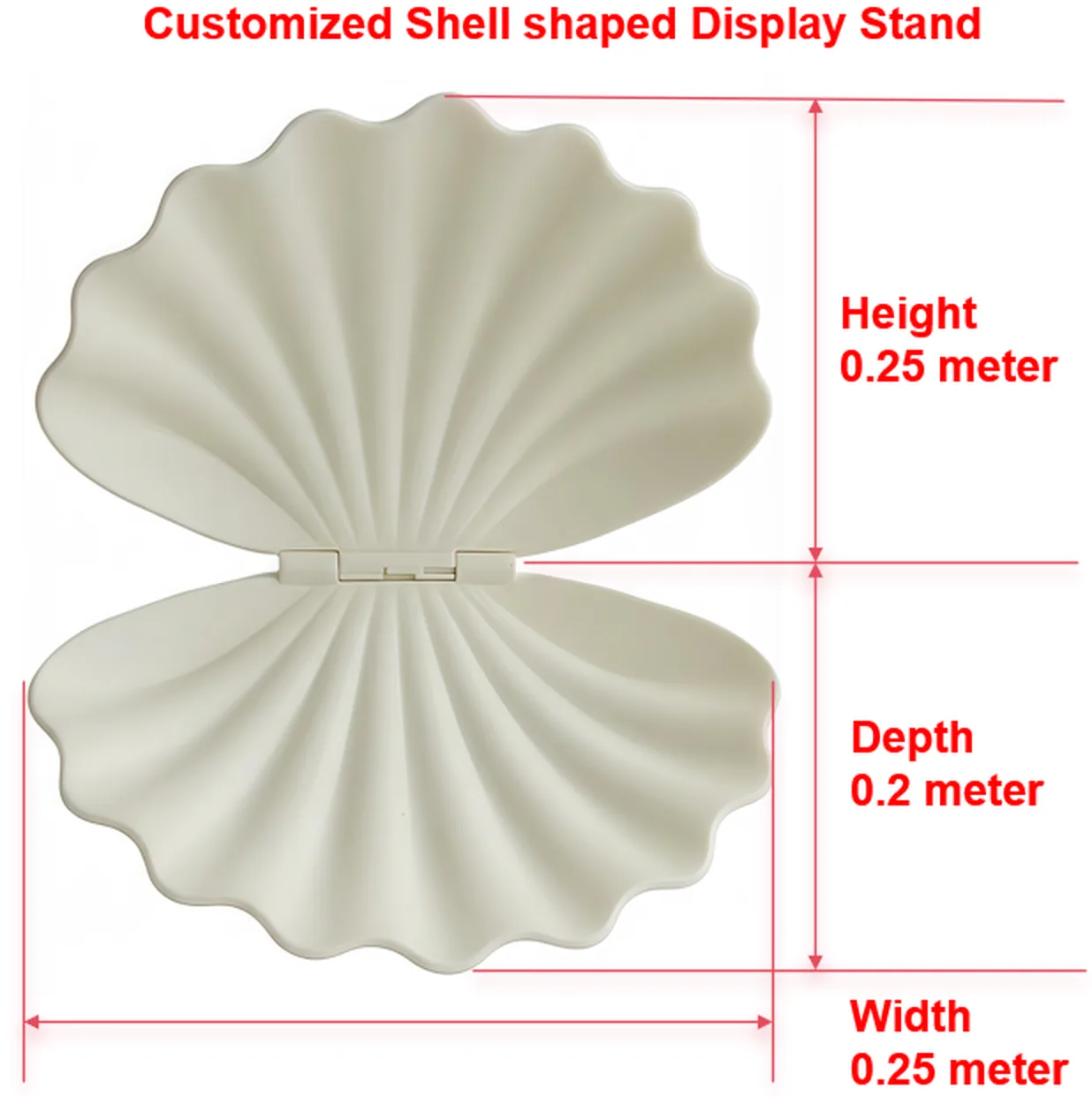
A hinged shell is two products, not one
The usual way to make a shell prop is a single hollow casting with a flat back. It is quick, it is forgiving, and it hides its own mistakes. A version that opens cannot hide anything, because both halves are visible at the same time and the seam between them runs right across the middle of the object.
The two leaves come off the same master, but that does not make them interchangeable. Each one is trimmed, sanded and coated separately, and every step moves the rim a little. By the time the pearl coat is on, the two halves no longer measure what they measured on day one. So the rim is worked to the closed position, not to the drawing: we keep the pair together through finishing and bring the edge in slowly until the lid seats with a light, even contact all the way round. A rim that touches at the wide part and stands open at the hinge is the failure mode, and it cannot be fixed with a thicker gasket.
The hinge itself is a flat plate let into the umbo on each leaf, with a pair of small knuckles at the centre. It is set below the surface, so when the shell closes, the join is a dark line rather than a raised ridge. That matters more than it sounds. A proud hinge casts a shadow, and a shadow across a pearl surface draws the eye straight to it.
We design these hinges as display hardware. They hold a lid open and closed through years of opening and closing in a window, and they are not structural. Put a heavy object on the upper leaf, or use the open shell as a shelf, and the load path changes completely. If you need that, say so at the brief stage and the piece is built for it from the inside out.
The pearl finish, and why it is the slow part
Pearl is not a colour. It is a clear coat with interference pigment in it, sprayed over a tinted base, and what the eye reads is the light coming back off the pigment. That is also why it is unforgiving. A flat white can be sprayed thick and sanded back. A pearl coat has a direction. Overlap it unevenly and you get banding; spray it too dry and it looks chalky; spray it too wet and the pigment flops and the surface goes milky in patches.
The shape makes it worse. The ribs catch light at different angles, so the finish is judged along the rib rather than across the face. We spray the deep part of the shell first and work outward to the scalloped lip, which keeps the overlap lines running the way the ribs run instead of cutting across them.
Then there is the colour target. The inside of a real shell is not one white. It drifts from a warm, almost creamy white near the opening to something cooler and greyer deep in the bowl, and the outer face is a different material again: chalky, matte, with fine growth lines. A single tone sprayed over the whole piece is what makes a shell prop look like plastic. On this build we matched the inner face to the reference shell and kept the outer face deliberately drier and less reflective, so the two sides of the piece read as two sides of a shell rather than as one moulding.
One practical note for anyone specifying pearl: it shows handling. Fingermarks sit on a pearlescent surface differently from the way they sit on gloss, and a shop that wipes the piece every morning with a general-purpose cleaner will wear the coat before a shop that dusts it. We send care instructions with every pearl-finished piece, and we would rather tell you that up front than have you discover it in month six.
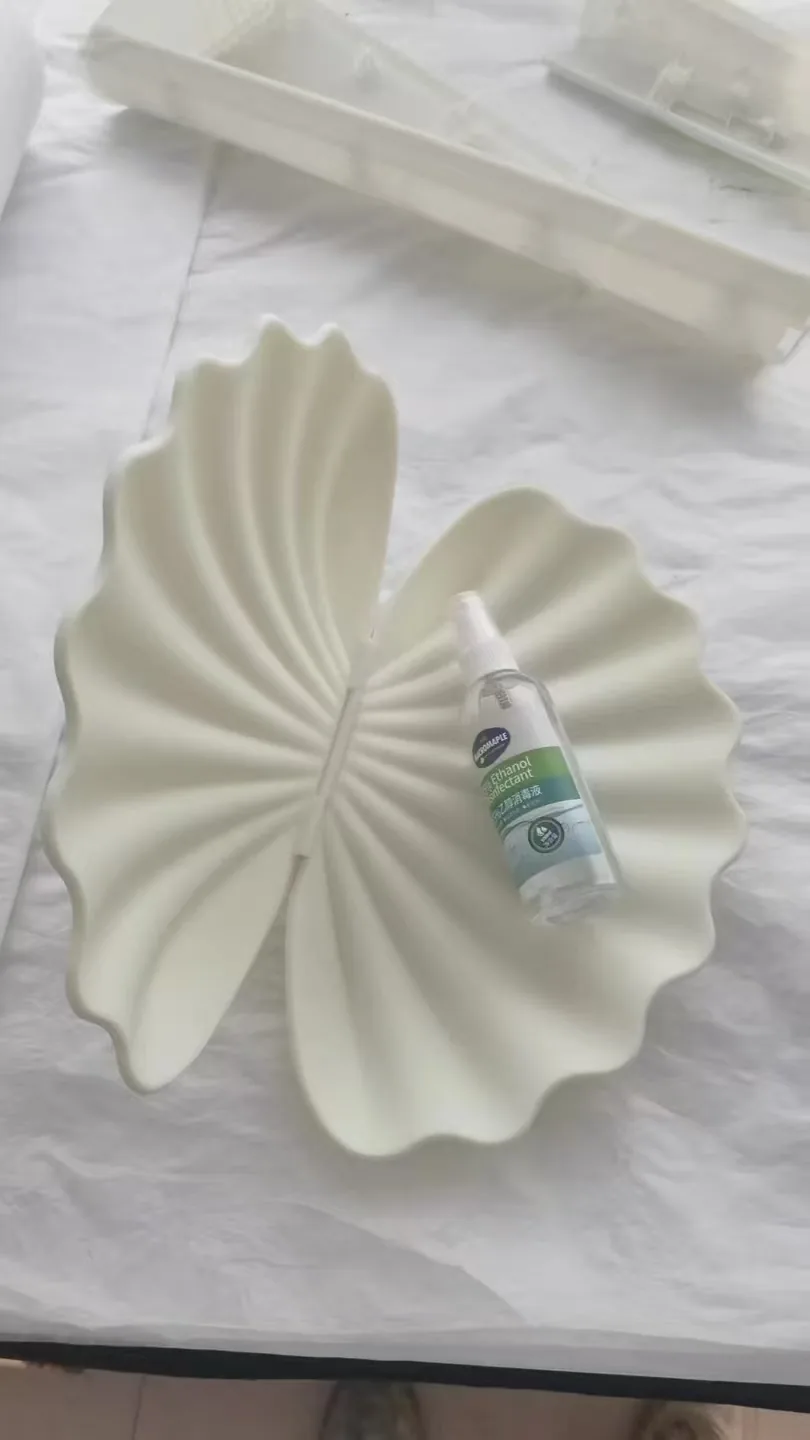
Copying the shell, not inventing one
The difference between a shell prop that convinces and one that does not is almost never the colour. It is the structure: how many ribs there are, how they fan out from the umbo, where the growth lines sit on the outer face, how thick the lip gets before it scallops, and where the two little ears at the top of the hinge end.
We work from a physical shell or from a scan, and we keep the asymmetry. Real shells are not symmetrical, and the small irregularities are what stop the eye reading a moulded shape. Where a client sends photographs, we ask for a scale in the frame and at least one straight-on view of the closed face, because that is the view the piece will be judged from on a shelf.
This is the part of the work we call museum-grade, and it is a build standard rather than a certificate. A museum object is looked at from close range, for a long time, by people with no reason to be generous. That sets four requirements above ordinary retail work. Nothing visible that should not be: no tool marks, no visible hinge hardware, no seam you can find by eye at the intended viewing distance. Nothing that changes with the room: the surface has to behave under raking light, under spots and in daylight. Nothing that depends on a good day: parts are made to the drawing rather than trimmed to fit, so a replacement leaf can be made months later and still close against its partner. And handling treated as part of the design: where people will touch it, what it is cleaned with, and how it is packed for a second move rather than only the first.
The 1.2 m prism acrylic displayis the same discipline applied to a transparent object, where there is nowhere to hide at all. A pearl shell is easier in one way and harder in another: you can bury a joint, but you cannot bury a mottle in a coating that is being read for the light it throws back.
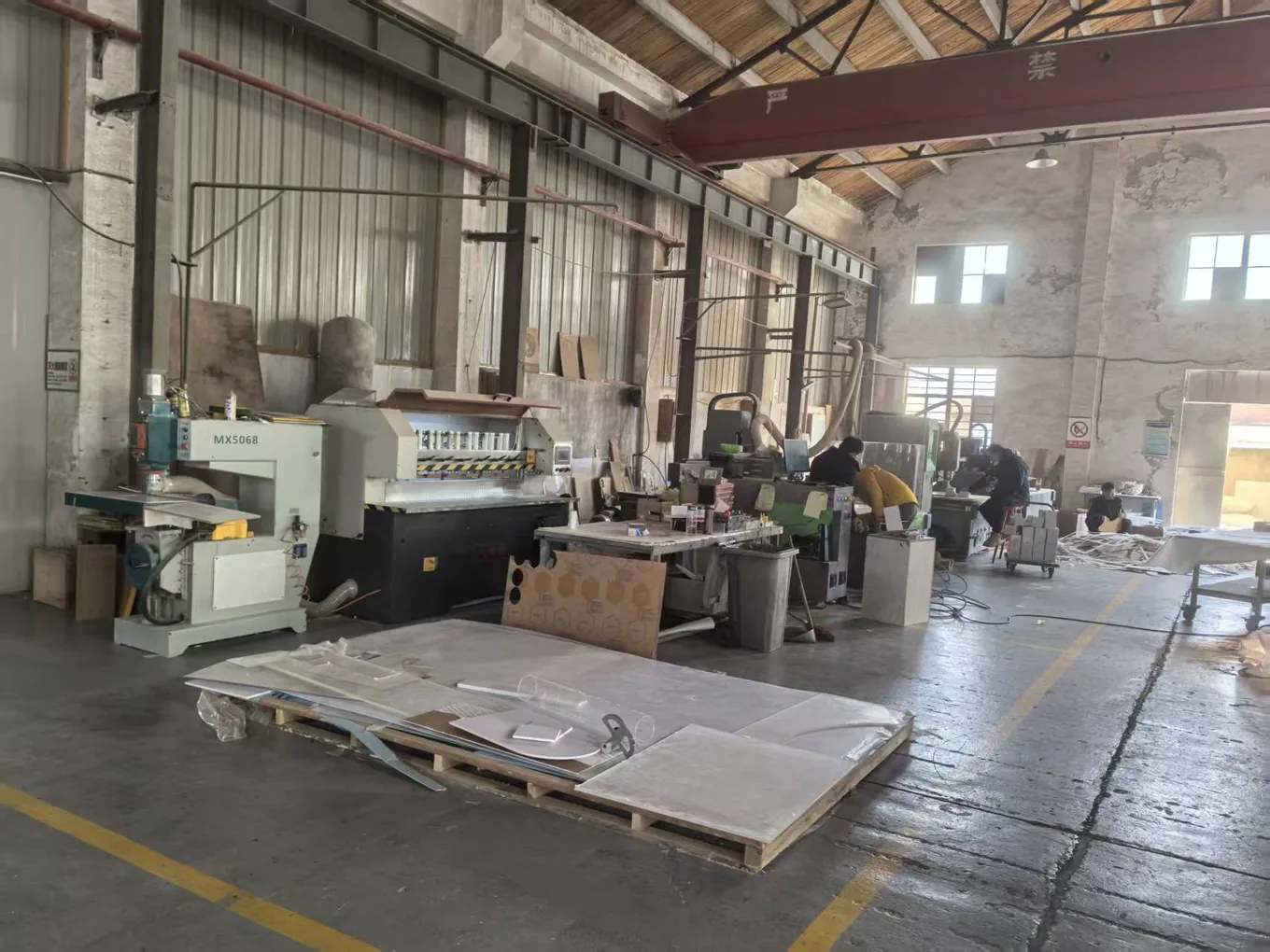
What we need from you
Four things turn a shell brief into a quotation, and none of them is a specification sheet.
- The reference. A real shell, or photographs with a scale, or an existing prop to copy. If you have a scan or a CAD file, better still.
- The size you want, and where it will stand. Counter, shelf, plinth or window floor. The same shell at 25 cm and at 60 cm are different builds, not a zoom.
- The finish and colour target, plus what will sit on it. A swatch, a Pantone reference, a photograph, or simply the shell itself. Tell us the weight and height of the product too, so the leaf is shaped to carry it rather than to look right empty.
- Quantity, destination and date. The destination decides the packing and the crating, and the date tells us whether the schedule is comfortable.
On rights: we reproduce shells and packaging that you own or are authorised to reproduce, and we ask for that in writing before tooling starts. Pieces ship unbranded by default. The process from brief to delivery is written up on the process page.
Where this piece will not work
Worth stating plainly, because a shell stand is easy to over-specify. It is not a structural shelf. The lower leaf carries what it is designed to carry, and the drawing states that figure; beyond it you are asking a display hinge to do a job it was not drawn for. A pearl coat is an interior finish: permanent sunlight will shift it, and outdoor use is a different brief. And the piece is not waterproof, because it is not meant to be. If any of those constraints is real for you, tell us, and we will quote something that suits instead of something that has to be replaced.
Common questions
Can the shell be a different shape, size or pearl tone?
Yes. The species, rib count and spacing, overall size and surface effect are all made to order, and the colour is matched to a reference you supply. Send a real shell, a photograph with a scale in it, or an existing prop to copy, and we work from that rather than from a generic mould.
Does the product sit on the shell by itself, or does it need a fixing?
For most retail use the piece simply rests on the lower leaf, which is dished by the shape of the shell. If the object is tall or top-heavy, we can build a shallow recess, a clear acrylic cradle or a discreet pin to hold it in position. Tell us what will stand on it, and we design for that weight and centre of gravity.
Can you reproduce the shell of a product we own?
Yes, to your approved reference, and the piece ships unbranded until you confirm the rights in writing. Minimum order is from 1 piece, and sampling takes around 15 days.
Planning a window or a launch display around a piece like this? Seedisplay props for retail and exhibitions, orsend us the shell, the size and the room it will stand in and we will come back on feasibility, materials and cost.